
日本語 | English | Tiếng Việt
How Safety Continues to Improve
Six-monthly review, notice flow, contract review, KY practice, and the improvement cycle.
Safety operation rules
Review and decision-making
- Major safety standards are reviewed every six months.
- Whether to issue a notice is discussed and decided by the management and the Tokyo and Osaka responsible persons at the Safety Meeting.
- Notices are issued by the management.
Compliance and partner company response
- Notices apply to all parties concerned, including partner companies.
- Partner companies that do not comply with notices are informed that the contract will not be continued. The requirement for compliance is communicated in advance, and in the event of non-compliance, the policy is to review contract continuation.
Collection and sharing of near-miss and accident information
- Near-misses and accident information are collected and shared on each occasion.
- Recurrence prevention is treated as learning for the entire company.
KY submission practice
- KY is submitted daily to the site responsible person (safety manager).
- KY content is prepared in line with the role of managers under the "Safety and Quality Declaration 2026" and in light of actual site conditions.
- Reporting must reflect the specific site; template-only entries ("template KY") are not accepted.
Why safety continues to improve
As a supplement to the Management Responsibility Structure, we explain what we do and why it reduces errors, through the structure.
1. Safety is managed by structure
Safety is not left to the attention or effort of individuals on site. Management takes responsibility, and safety is managed through organizational structure.
- Safety is not left to the site alone. Standards and notices are made clear, and who is responsible for what is defined by role.
- Management takes responsibility. Notices are issued by management; major safety-related decisions involve the management layer.
- Decisions are made at the Safety Meeting. Management and the Tokyo and Osaka responsible persons discuss at the Safety Meeting and decide whether to issue a notice.
In this way, safety is managed not by "someone being careful" but by roles and procedures.
2. Review of standards every six months
Major safety standards are reviewed every six months. They are not left fixed.
- Major standards are reviewed every six months. Content is not left as decided once; it is reviewed on a regular schedule.
- Near-misses are also considered. Near-misses and accident information reported from the field are collected and shared and used as input for review.
- Standards are not fixed. When incidents occur, they are reflected through review rather than leaving standards unchanged.
As a result, the same type of incident is less likely to repeat when it is already known. Incidents do not accumulate because the structure allows standards to be updated continuously and past incidents to be reflected.
3. Flow of notice decisions
Notices are decided through discussion at the Safety Meeting and follow the flow below from decision to issuance to the site.
- At the Safety Meeting, management and the Tokyo and Osaka responsible persons discuss.
- Based on the discussion, management decides whether to issue a notice.
- Based on that decision, the notice is issued.
- The issued notice is published on the website so that those concerned can refer to it.
- Where necessary, it is incorporated into work procedures so it can be executed on site.
Simple flow
Safety Meeting → Discussion → Management decision → Notice issued → Website publication → Work procedure
This flow ensures that notices are consistent in terms of who decided, where they can be found, and how they are executed.
4. Ensuring effectiveness
Notices have little effect if they are only posted. Effectiveness is ensured by clarifying the scope of application and how non-compliance is handled.
- Notices apply to all parties concerned. They apply to all relevant parties, including partner companies.
- Non-compliance leads to review of contract continuation. Partner companies that do not comply with notices are informed that the contract will not be continued. The requirement for compliance is communicated in advance; in the event of violation, contract continuation is reviewed.
- Safety is not a voluntary target. It is positioned as a standard to be complied with, and violations are handled according to policy.
In this way, notices are not left as "merely stated"; they are structured to have effect.
5. Daily KY practice
KY (hazard prediction) is submitted daily to the site responsible person. To prevent it from becoming a formality, the following rules apply.
- Submitted daily to the site responsible person. The recipient is limited to the site responsible person (safety manager), who checks the content.
- Template KY is prohibited. Repetition of the same text does not reflect conditions of the day and is not accepted.
- Reports must reflect site conditions. Content must relate to the day's work, location, and risks.
Requiring daily submission avoids a practice of "writing only sometimes"; prohibiting templates and requiring situation-based reporting make it difficult for empty submissions to pass. The system is designed to prevent formalization.
Improvement cycle
Safety is not decided once and left as is. It continues to improve through the following cycle.
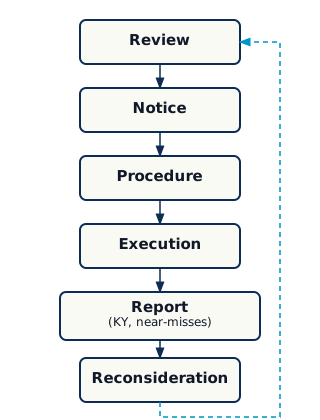
The six-monthly review and daily KY and near-miss reporting are part of this loop. The results of reconsideration feed into the next review and into updates to notices and procedures. As a structure, safety is designed to continue to improve.
Back to Safety and Quality System Top Safety and Quality Declaration 2026